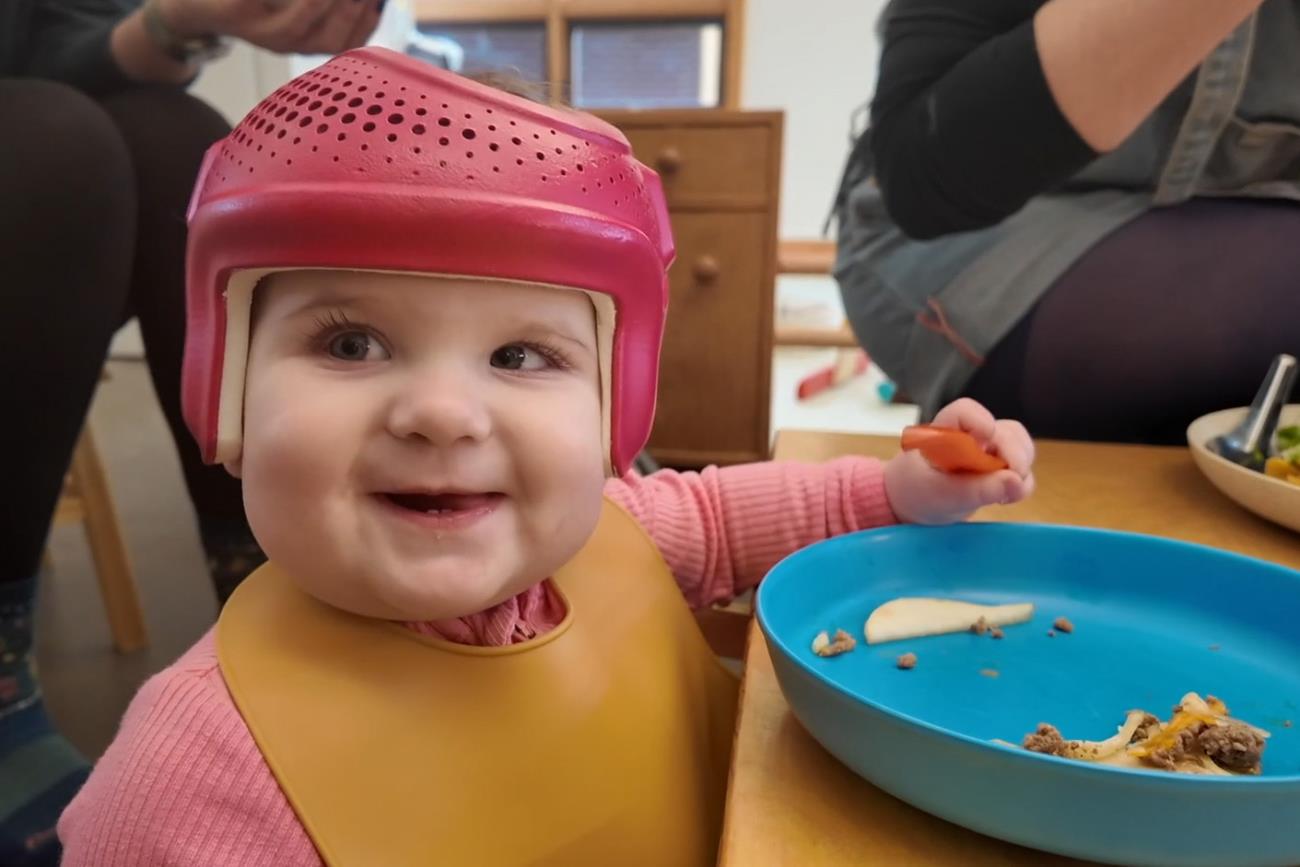
As we enter the season of many holidays, it is a wonderful time to reflect on all the meanings that food can have. Food can be used as a means of connection, showing love, building community, and preserving traditions. In the Nido, meals are a central part of our community. Exploring food provides young children with opportunities to develop focus and patience, as well as fine and gross motor skills and language.
With considerations made for food shape and texture, we serve babies lunch and snacks every day. The adults in the environment sit down and eat with the babies to help model taking bites and utilizing utensils. The children in the Nido are learning the rhythm of meals through repetition. Every day, we begin by washing our hands at the sink. They then make their way to the table and wait to be served food. Once everyone has joined the community table and has a plate of food, we sing the same song that all the other environments at our school sing at meals: “Look around and you will see/ community, a family/ we’re together, we are one.” The children explore their food independently, ask for more, and eventually make it clear that they are done. Older children will carry their plates to the compost and then deposit them in the dish tub before returning to the sink to wash their hands. This cycle is repeated at meal times throughout their entire Nido experience.
Whether the babies start with Baby Led Weaning (BLW) or purees, we practice infant self-feeding. For babies having purees, they will sit at the table and be offered a pre-loaded spoon that they can then bring to their mouths. We will trade spoons with them until they become interested in loading their own utensils by scooping or dipping them in a bowl. For babies eating table foods, we offer them a plate of the same food that we are eating. Younger babies are offered larger pieces of food so that they can have more success with picking them up and bringing them to their mouths. Here is a (long, but so informative) page on food sizes and shapes.
Spoons, stick-shaped teethers, and larger pieces of food also help with oral mapping skills that will help with the development of chewing later on. Our youngest eaters frequently gag while exploring teethers, spoons, and food, which is important for them to learn how far back it is safe to put things in their mouths. There are excellent videos available that explain the difference between gagging and choking. Gagging and funny faces don’t mean that babies dislike a particular food; they are just part of the experience of food exploration.
It is so important that babies have the opportunity to explore foods and get messy. As they explore at the table, they are exposed to various textures and temperatures. They develop confidence as this is one of their first chances to be truly independent; we can support this by allowing them the freedom to explore various ways of getting the food to their mouths. Mixing foods that seem unpalatable to us frequently happens, and we support them without negative commentary.
As babies explore food at the table, they are developing their hand strength and precision with their various grasps. Closer to nine months, we see them begin to use their thumb in opposition to one or more fingers to pick up smaller bites of food, so we transition to serving them more diced-up options to provide opportunities to strengthen their pincer grasp. Also, sitting at the table is great for their gross motor development as well as it requires core strength to sustain the seated position.
At the table, we use the signs for “eat,” “drink,” “water,” “milk,” “more,” “sit,” and “all done.” We verbalize these words while signing them to help connect the sign to our spoken language. We never expect the babies to ask for more, but we will say and sign “more” in response to shouts and pointing before helping to tong or spoon more food onto their plates. As they get older, we begin to see the babies making their own approximations of these signs both at and away from the table. We see “all done” in situations they would rather avoid and “more” at Group when they hear a favorite song.
Mealtime is full of opportunities for young children to construct themselves. It encompasses all the important skills that are developed during their time in the Nido, and I am fortunate to help support and facilitate this growth every day in our environment.
.jpg "compass-montessor-junior-high-detroit-trip-(5).jpg")
Our journey to Detroit started bright and early. As we drove our school vans into the city, we made memories that will last a lifetime. When we finally arrived after the vigorous drive, we headed straight to the DIA. We got to take in meaningful art and creations while reflecting on the pieces we loved. We described what we saw, thought, and wondered about five pieces in five different, unique exhibits. This truly helped us break down the art and gain a deeper understanding of it. After the DIA, we went to Meijer and got our food for the week! Soon after, we ended our day at the tasty Bucharest Grill.
.jpg "compass-montessor-junior-high-detroit-trip-(6).jpg")
On day two, we had a slow morning that we enhanced with a fresh variety of bagels, and many indulged in warm tea. After the morning meeting, we ventured over to the Charles M. Wright Museum. This museum taught us all about African American history. Our lovely tour guide, Ja-tu, not only took us through a museum but also took us through a story. The rooms and makeshift town really made us feel deeply about this topic and truly opened our eyes to history. After the museum, we had a lovely picnic-like lunch at Lasalle Park. After filling ourselves with delicious sandwiches, we ventured to the Motown Museum. Here, we learned almost everything about Motown and truly dived deeply into this topic. We even got the opportunity to stand in the studio where famous Motown artists such as the Temptations and Stevie Wonder once sang. After learning the Temptations walk, we headed back to the hostel to relax before the Detroit Pistons game.
.jpg "compass-montessor-junior-high-detroit-trip-(8).jpg")
When we arrived at the Detroit Pistons game, we found our seats and got Detroit style pizza and other flavorful food items. After we munched on our food, the basketball was tipped, and the game began. We were all very hyped and having the time of our lives, and, of course, the goal is to get on the Megatron; we achieved that goal 14 times!! Thank you to the guides for putting up with our shenanigans!
.jpg "compass-montessor-junior-high-detroit-trip-(11).jpg")
Now, day three was upon us. We started our day full of learning at the Ford River Rouge Plant. We got to watch two very interesting presentations; one about history and the second all about how to build an F-150. Everyone really enjoyed the elaborate presentation on the step-by-step process of how to build the Ford F-150. After, we walked through the manufacturing and assembly lines. Our wonderful tour guides helped show us all the cool tools and machines that are used. After we left the plant, we enjoyed lunch at the Michigan Central Station. We got to go inside and learn about the history. After our time at the station, we visited the famous Belle Isle. We got to see the oldest aquarium in the US and a beautiful conservatory. After seeing all the types of fish, we headed downtown to look at all the monuments and learn more about the history of our country. We explained our knowledge about the underground railroad and the Civil War. After our brief history lesson, we had dinner at the Detroit Shipping Co. After a wonderful dinner, we called it a night and headed home.
.jpg "compass-montessor-junior-high-detroit-trip-(10).jpg")
Sadly, the fourth day had come, and it was time to head home. But first, we got to visit Greenfield Village. This village is a collection of historic houses founded by the Ford family. The village is basically a living outdoor museum. Here, there is a famous working carousel, a farm, and a Model T drive. We got to ride a horse carriage, enjoy a carousel built in 1913, and even stand in Thomas Edison's famous laboratory. After another wonderful historical experience, we headed home in our vans.
.jpg "compass-montessor-junior-high-detroit-trip-(12).jpg")
Thank you so much to our guides and the school for letting us have this wonderful trip in Detroit!
Student Biographers: Ava and Gwendolyn
Student Photographers: by Olivia, Vaughn, Adrienne, and Hank
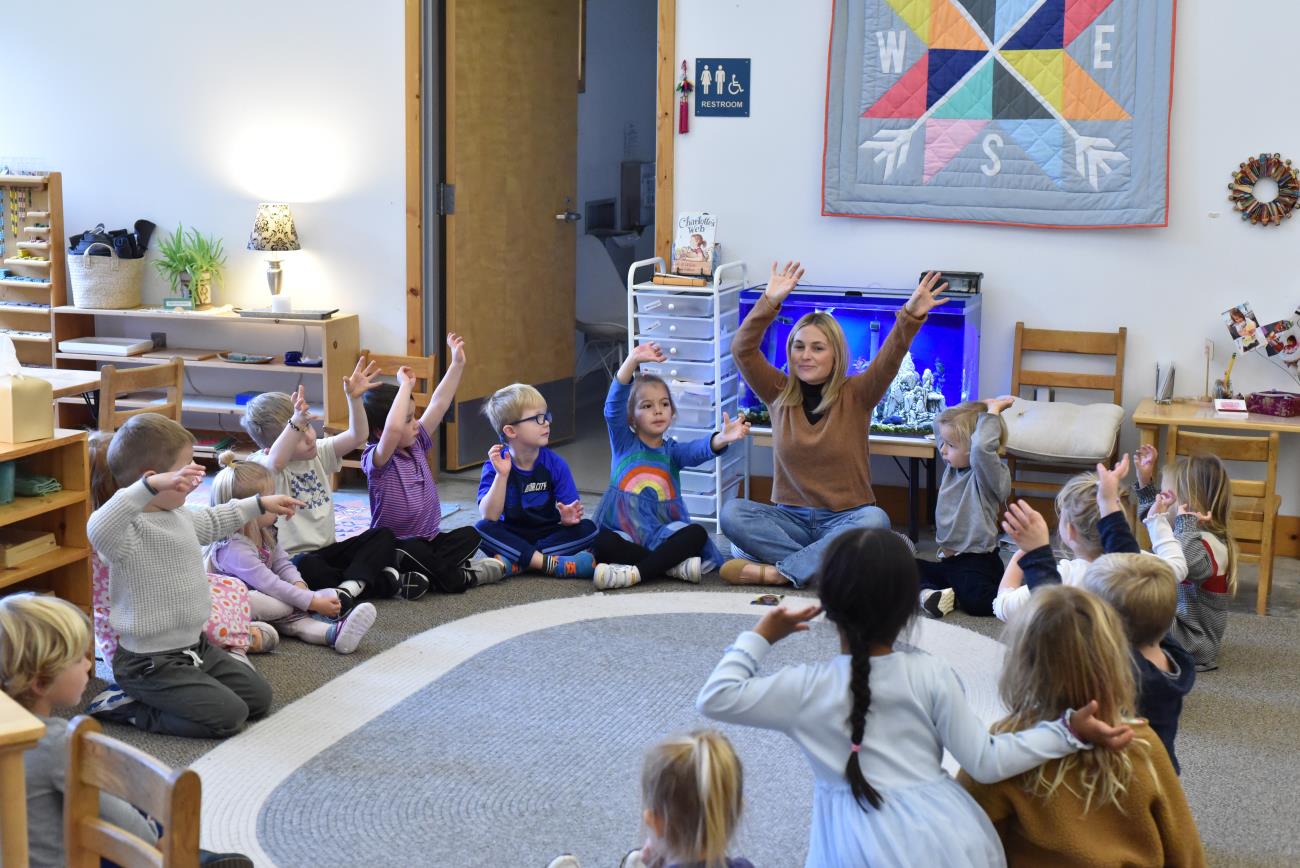
When I think about The Children’s House, one simple truth comes to mind: this place is me.
I was a Montessori child. Like so many of our students, I had the freedom to move, to ask questions, and to explore things deeply without someone rushing me to the “right” answer. That early experience shaped me in ways I didn’t fully understand until much later.
As an adult, I became a traditional teacher. I stepped into that world because I loved children, but something didn’t feel right. I found myself constantly pushing against the structure. I was rushing children, correcting them, and silencing their curiosity so we could “stay on schedule.” Eventually, I realized that everything I knew about children and how they truly learn, I could not do in that setting.
So I came home to Montessori.
I moved to Traverse City for a position at The Children’s House. I then married a Children’s House alum. And now, our two-year-old daughter is part of the Young Children’s Community.
This place, this philosophy, is in every corner of my life. It’s how I parent. It’s how I teach. It’s how I live. It’s not just a job. It’s my family. It embodies everything I believe about children, about people, about what it means to grow.
This growing journey I’ve experienced as a Montessorian, as a professional, and as a mother, it’s mirrored every day in the classroom. We talk about the children growing, but the adults grow too. We grow together.
Montessori is not about adults pouring knowledge into children like empty vessels. It’s about guiding them as they construct their own understanding, through curiosity, independence, and exploration.
That’s why, when a child builds the Pink Tower out of order, I don’t correct them. I wait. I wait for them to notice it’s wobbling. I wait for the moment the pieces click into place (not just physically, but in their minds). When their eyes light up with that moment of I did it, that’s the magic.
It’s why, when they ask a question I don’t know the answer to, we research together.
It’s why I don’t rush to solve their conflicts. I sit back, I observe, I trust. Because I know they can do it. And when they do, they grow. And so do I.
These intentional practices don’t just stay in the classroom. They change who we are as people.
When I leave school and see a neighbor struggling with groceries, I remember how we show kindness in the classroom, and I offer to help. When I sit down to dinner with family members who see the world differently than I do, I remember how we guide children to navigate disagreement with respect and curiosity…and I try to do the same.
This community doesn't just grow children. It grows people. It grows parents, and teachers, and neighbors, and citizens of the world. It shapes who we are and who we are becoming.
Because of you, we can create environments full of beauty and intention. Because of you, teachers like me are supported to continue growing. Because of you, children are empowered to become thoughtful, compassionate, capable human beings.
From the bottom of my heart, from one Montessori child, teacher, mother, and now a Children’s House parent to another, thank you for growing with us.