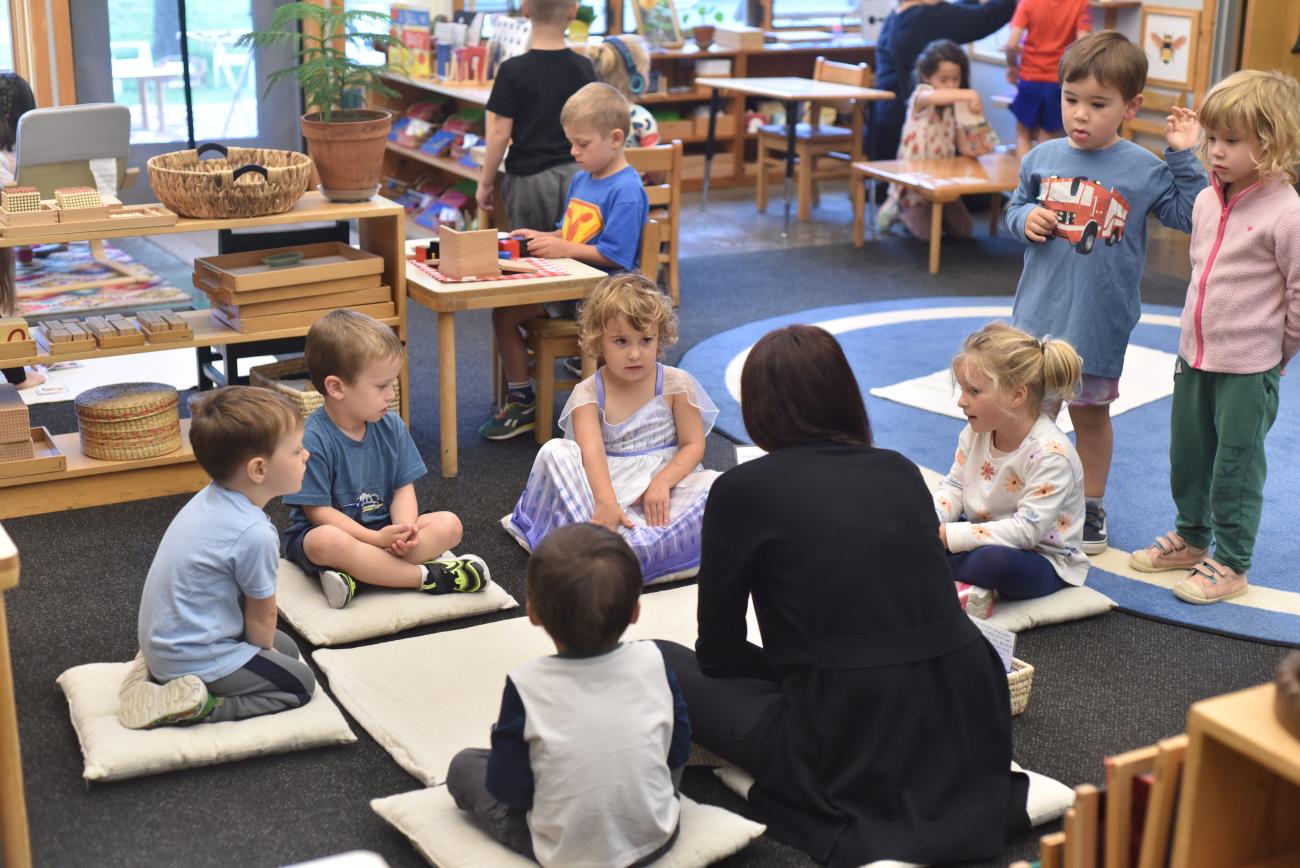
When people imagine a Montessori Primary classroom, they often picture small children quietly working with beautiful materials. While that image isn’t wrong, it barely scratches the surface of what truly unfolds each day. A Primary environment is alive, humming with purpose, curiosity, movement, connection, and, yes, a little bit of chaos sprinkled throughout.
This is a space where independence is practiced in a thousand small ways, where learning is not rushed or forced, and where children are trusted to follow an inner drive toward growth. It is a place where a three-year-old learns to pour water with care, a four-year-old writes their first word, and a five-year-old steps confidently into the role of leader, all within the same morning.
A day in Primary is not defined by a clock (unless it is gym day) so much as by rhythm. There are long stretches of uninterrupted work, moments of deep concentration, bursts of joyful collaboration, and quiet pauses for rest and reflection. Social learning happens alongside academic discovery, and emotional growth is honored just as much as intellectual achievement.
This post is an invitation to slow down and step inside that rhythm. To walk through a day as the children experience it. To see how the environment, the guide, and the community work together to support the whole child.
Opening the Door to TCH
Children arrive at various points throughout the morning. Some help Anna turn on the lights in the hallway, while others join Michele at the front doors to welcome arriving friends. Our mornings are intentionally soft, unhurried, and calm. Children are greeted not only by adults, but by peers as well, reinforcing that this is a shared community from the very start of the day.
Upon entering the coatroom, children independently hang their backpacks and jackets, change their shoes, and then joyfully enter the prepared environment, eager to reconnect with friends and familiar work. As they arrive, children naturally take part in preparing the space for the day, emptying the dishwasher, taking down chairs, turning on lamps, and folding laundry. As the environment slowly comes together, the children settle into choosing their work, marking the gentle transition into the uninterrupted work cycle.
The Uninterrupted Work Cycle
One of the most beautiful aspects of a morning in a Primary community is the absence of an adult-driven schedule. The work cycle is a protected and uninterrupted space, essential for children to develop deep concentration and meaningful learning. Within this time, children are free to choose work that both stretches their abilities and nourishes their inner drive to learn.
Focus and energy naturally ebb and flow throughout the morning. There are moments when the room feels busy and full, and just as quickly, it settles into quiet, purposeful concentration. Snack is available throughout the work cycle, allowing children to listen to their bodies and respond to hunger when it arises. This practice supports growing self-awareness while also offering natural limits. Children learn to balance their needs with the needs of others.
During this time, the guide moves thoughtfully through the environment, offering lessons one-on-one or in small groups, responding to what each child is ready for in that moment. Nearby, other children often observe, watching carefully, absorbing, and learning how to respectfully share space and honor another’s work. Throughout the morning, Practical Life, Sensorial, Language, Math, and Cultural studies weave together seamlessly, creating a rich and interconnected learning experience that feels both intentional and organic.
And just like that, the work cycle gently comes to a close. Children restore their work, returning materials to the shelves with care and readiness for the next person who will use them. As the environment is put back in order, the rhythm of the day begins to shift.
Lunch and Kindergartners
Kindergartners naturally step into the responsibility of preparing for lunch, while the younger children gather for joyful singing and movement. The classroom transforms from a space of individual focus and concentration to one of shared tradition and community. Preparing for lunch is meaningful work in itself. Through collaboration, the Kindergartners move tables and chairs, carefully set places with placemats, napkins, cups, utensils, and water pitchers, and take pride in creating a welcoming space for all.
Two days a week, this transition includes a trip to the gym for the younger children, while on other days, the community moves seamlessly from the work cycle into lunch together.
Lunch is a sacred pause in the day. The transition into eating is almost magical. Children sit with food in front of them, practicing patience and self-control as they wait together for our collective deep breaths, followed by our poem of gratitude. And then the phrase they have all been waiting for, “Buon Appetito! Manga!” In this shared moment, the room feels calm and connected, grounded in a simple ritual that signals care and togetherness.
As lunch unfolds, children practice many layers of independence and grace. They pour their own water, use utensils with intention, engage in conversation, and remain seated as they enjoy their meal. These moments are about far more than eating; they are opportunities to care for themselves, respect the community, and build confidence in everyday skills.
And just as naturally as it begins, lunch comes to an end. Children clean up their individual spaces, restoring the environment and preparing for the next rhythm of the day.
Recess
Following lunch, the community transitions outdoors, where the work of preparing for winter weather begins. The coatroom fills with the familiar rhythm of dressing. “Snowpants, boots, coat, hat, mittens,” a song that can be heard for much of the transition, offering both structure and joy as children move through each step. Dressing for the weather becomes its own kind of work, one that builds perseverance, coordination, and trust in oneself, before the children head outside, ready to meet the season.
Half Day and Nap
As the day reaches its midpoint, we say farewell to our half-day community members and begin the transition into rest for our youngest children. The pace naturally slows, and the environment grows quieter, honoring the need for restoration after a full morning of work.
Afternoon Work Cycle
While the younger children rest, the older children return inside from recess for afternoon read-aloud, a grounding moment of connection where the older children settle in to listen to a chapter book.
Following read-aloud, children move into the afternoon work cycle. Much like the morning, this time is rooted in choice and independence, though it unfolds with a slower, quieter energy, offering space for reflection, creativity, and continued exploration as the day gently carries on.
Kindergarten Physical Education
As the afternoon work cycle comes to a close, the Kindergartners prepare for what many eagerly describe as the highlight of their day: Kindergarten Gym. With energy renewed and bodies ready to move, they gather their belongings and transition together, excited for this daily opportunity to challenge themselves physically and collaboratively.
While the Kindergartners are at gym, the remaining children turn their attention to preparing for the end of the day. Snack is set out with care, the environment is gently restored, and children gather on the rug, waiting for the community to be whole again.
Once everyone has returned, we enjoy a shared snack, a final moment of connection before transitioning home or into Friends Club. It is a simple and meaningful close to the day, offering time to reflect, reconnect, and ease gently into the next part of each child’s afternoon.
As the day draws to a close, the rhythm comes full circle. At carline, each child is walked to their waiting adult, a quiet moment of connection bridging school and home. With a warm “see you tomorrow,” we move to the next chapter of our days.
Thank you for joining us on this journey! See you soon!